
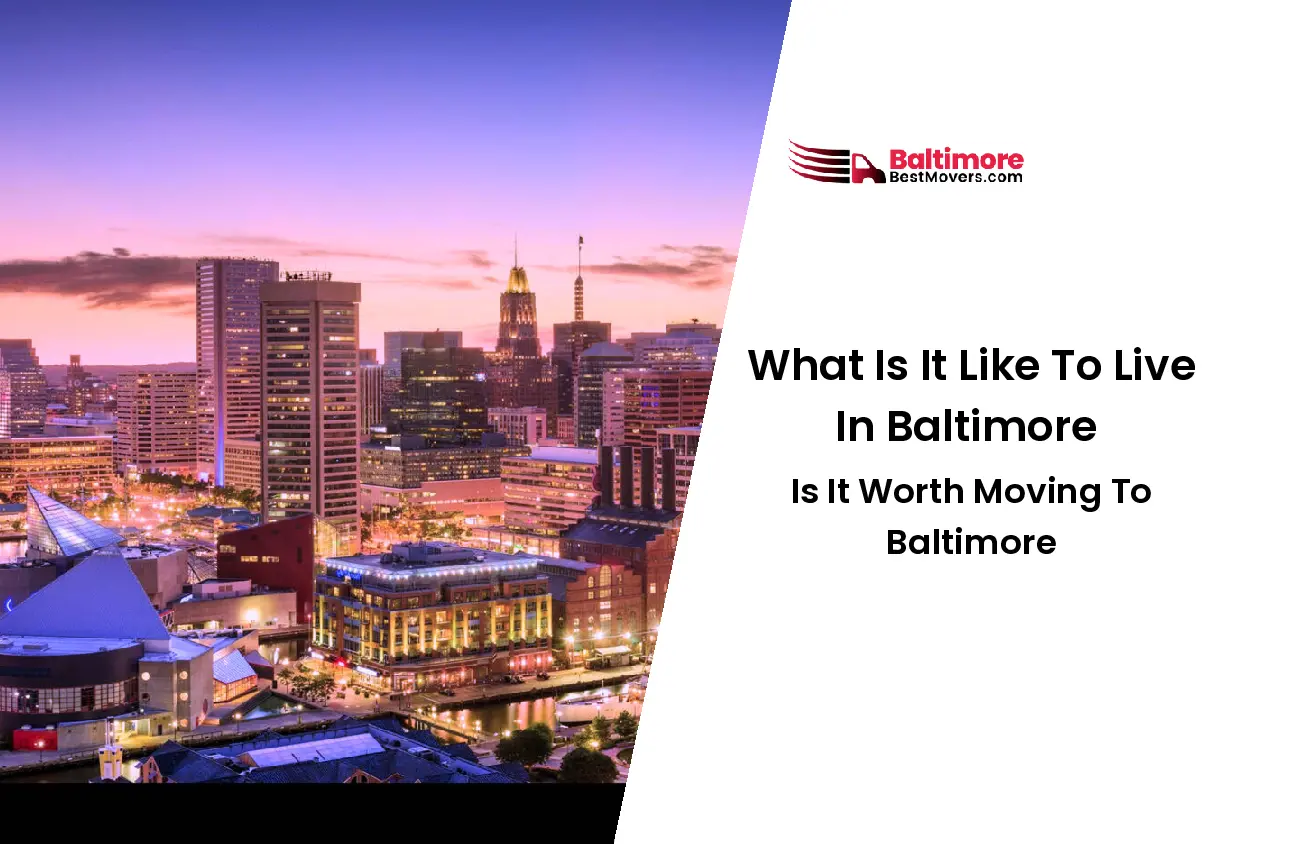
What Is It Like To Live In Baltimore | Is It Worth Moving To Baltimore
Moving to Baltimore means relocating to the largest city in Maryland, home to 568,271 residents, located on the Interstate 95 corridor between Washington, D.C., and Philadelphia. Known nationwide as “Charm City,” Baltimore is an independent city that combines a historic waterfront setting with the energy of a modern urban hub, making it an attractive place for relocation.
Major attractions shape Baltimore’s identity, from the Inner Harbor and the National Aquarium to Oriole Park at Camden Yards and Fort McHenry, birthplace of the national anthem. These landmarks, together with museums, theaters, and festivals, connect history with a lively present. The city’s four-season climate, with warm summers and crisp winters, adds variety to year-round activities.
Life in Baltimore extends beyond tourism with a strong job market in healthcare, shipping, and education. A lower cost of living than nearby Washington, D.C., affordable housing, respected universities, and diverse nightlife make the city appealing to families, students, and professionals planning a move.
Is Baltimore a Good Place to Live?
Yes, Baltimore is a good place to live, offering a mix of affordability, opportunity, and culture that appeals to newcomers. With a cost of living below the national average and housing more affordable than in nearby Washington, D.C., the city provides clear financial advantages for families, students, and professionals.
This affordability connects directly to opportunity. Baltimore’s job market is supported by world-class employers like Johns Hopkins University and Johns Hopkins Hospital, while industries in technology, shipping, and education continue to expand.
Strong career prospects are matched by quality education. From Johns Hopkins University and Loyola University Maryland to respected schools such as Roland Park Elementary/Middle and Baltimore Polytechnic Institute, learning options are wide-ranging. Combined with a lively arts scene and diverse neighborhoods, these factors make Baltimore a rewarding place to call home.
Where Is Baltimore Located?
Baltimore is located in the central part of Maryland along the Patapsco River, an arm of the Chesapeake Bay, giving it a historic maritime setting and strategic access to the East Coast. As the largest city in Maryland and an independent city, it has long served as both an economic hub and cultural center for the state. Its location has shaped Baltimore’s role as a major port and business gateway, while also supporting the city’s growth in education, healthcare, and shipping. This combination of waterfront placement and regional importance makes Baltimore a key urban center in the Mid-Atlantic.
What is the Absolute Location of Baltimore?
The absolute location of Baltimore is 39° 17′ 57.2496” N latitude and 76° 36′ 33.7788” W longitude, set in central Maryland along the Patapsco River and Chesapeake Bay. The city is connected by Interstate 95, linking it to Washington, D.C., and Philadelphia, and by Interstate 83 and Interstate 70, which extend north and west. These highways, along with the Baltimore Beltway (I-695), make Baltimore an important Mid-Atlantic hub for travel, commerce, and regional connectivity.
What is the Relative Location of Baltimore?
Baltimore is located in the central part of Maryland, along the Patapsco River and Chesapeake Bay. It sits about 40 miles northeast of Washington, D.C., 100 miles southwest of Philadelphia, and roughly 188 miles south of New York City, making it part of the Northeast corridor. The city is bordered by Chesapeake Bay waters to the east and the Piedmont Plateau to the west. With direct links to Interstate 95, Interstate 83, and Interstate 70, Baltimore connects easily to nearby metropolitan areas and major East Coast destinations.
Which State is Baltimore In?
Baltimore is in the state of Maryland, where it serves as the largest city and primary economic center. Unlike most cities, Baltimore is an independent city, separate from any county. Maryland lies in the Mid-Atlantic region, bordered by Pennsylvania, Delaware, Virginia, and West Virginia. Known for its strong economy and coastal access, Maryland relies on Baltimore as a hub for commerce, healthcare, and education, making the city central to the state’s growth and identity.
Which Country is Baltimore In?
Baltimore is in the United States of America, situated in the Mid-Atlantic on the nation’s East Coast. As Maryland’s largest city, it serves as a hub for commerce, healthcare, and education. Its location on the Chesapeake Bay has made it a historic port city and a vital link in America’s economic and cultural growth.
What Time Zone is Baltimore In?
Baltimore is in the Eastern Time Zone (ET) of the United States. The city observes Eastern Standard Time (EST, UTC−5) from fall through winter and switches to Eastern Daylight Time (EDT, UTC−4) during spring and summer months as part of daylight saving. This time zone alignment connects Baltimore with other major East Coast cities such as New York, Philadelphia, and Washington, D.C.
What is the Population Of Baltimore?
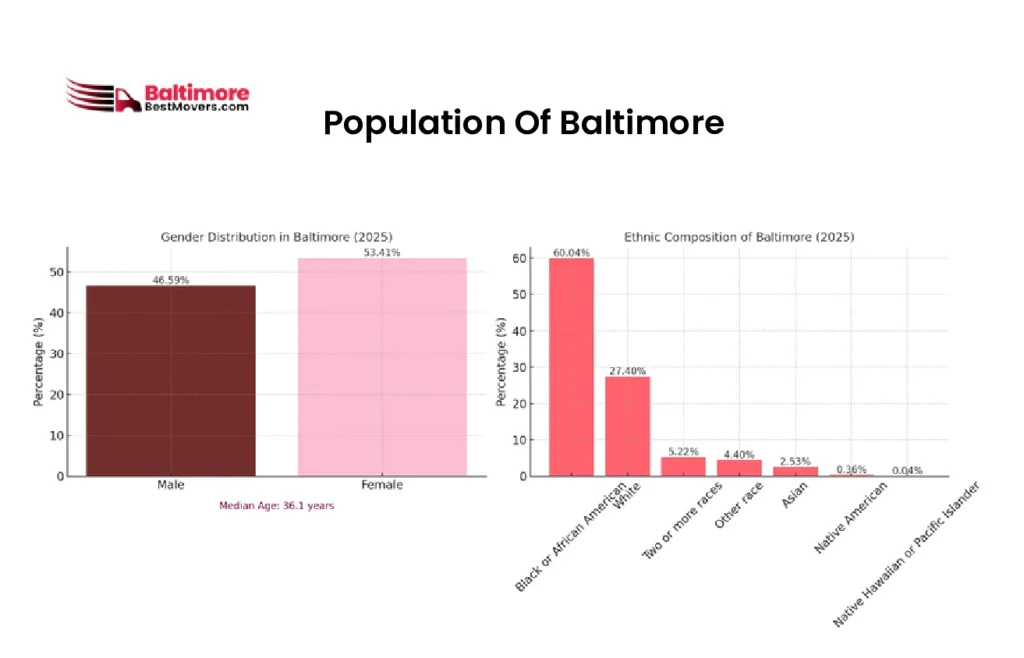
According to World Population Review, Baltimore has an estimated population of 557,503 residents in 2025, making it the largest city in Maryland and an important hub in the Mid-Atlantic region. The greater Baltimore metropolitan area, which includes surrounding counties, is home to more than 2.8 million people, reflecting the city’s central role in commerce, education, and healthcare.
Here is a breakdown of population demographics in Baltimore:
Gender and Age Distribution:
- Male: 46.59%
- Female: 53.41%
- Median Age: 36.1 years
Ethnic Composition:
- Black or African American: 60.04%
- White: 27.4%
- Two or more races: 5.22%
- Other race: 4.4%
- Asian: 2.53%
- Native American: 0.36%
- Native Hawaiian or Pacific Islander: 0.04%
Who is From Baltimore?
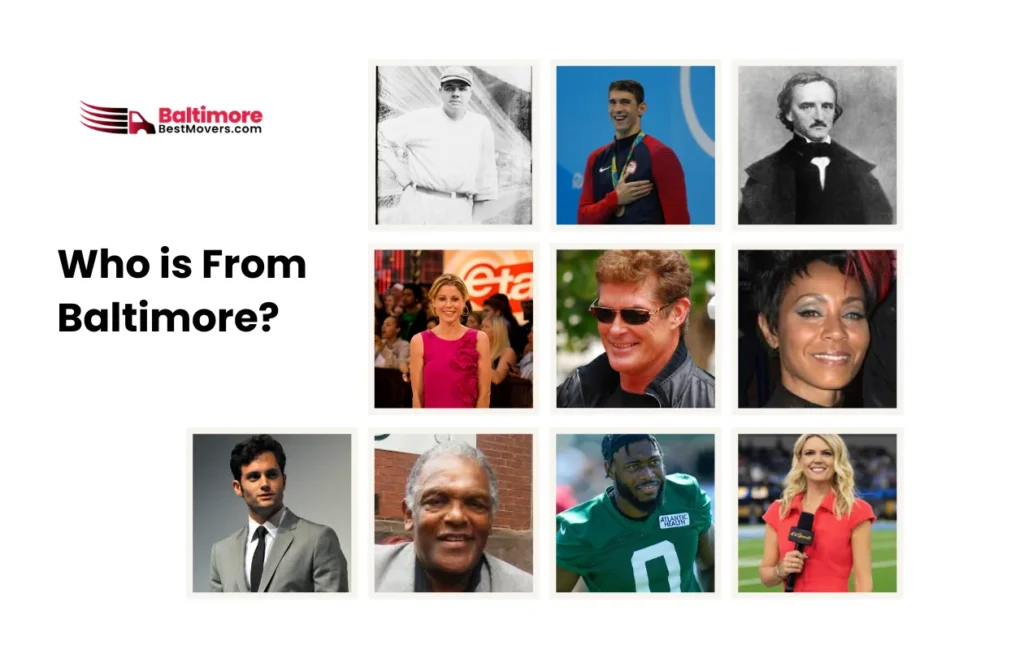
Baltimore is home to several notable individuals who have achieved national and international recognition in sports, literature, television, and entertainment. Here are some of the most famous personalities connected to the city:
- Babe Ruth: Legendary Major League Baseball player, widely regarded as one of the greatest athletes in history.
- Michael Phelps: Olympic swimmer and the most decorated Olympian of all time, with 28 medals.
- Edgar Allan Poe: Iconic American writer and poet, best known for The Raven and his influence on Gothic literature.
- Julie Bowen: Emmy Award-winning actress, recognized for her role on Modern Family.
- David Hasselhoff: Actor and singer, best known for Knight Rider and Baywatch.
- Jada Pinkett Smith: Actress, producer, and talk show host, famous for films like The Matrix series.
- Penn Badgley: Actor and musician, known for Gossip Girl and Netflix’s You.
- Lenny Moore: Pro Football Hall of Famer, celebrated for his career with the Baltimore Colts.
- Adrian Amos: NFL safety, known for his strong performances with the Green Bay Packers and New York Jets.
- Melissa Stark: Sports broadcaster and journalist, currently a reporter for NBC’s Sunday Night Football.
What is the Main Language of Baltimore?
The main language spoken in Baltimore is English, used by the vast majority of residents in daily life, business, and education. While English dominates, the city’s diverse population contributes to a range of other languages spoken at home.
Here is a breakdown of language use in Baltimore:
- English only: 87.6%
- Spanish: 6.2%
- Other Indo-European languages: 2.5%
- Asian and Pacific Islander languages: 2.1%
- Other languages: 1.6%
What Government Type Does Baltimore Have?
Baltimore operates under a mayor-council system of government. The city’s Mayor is Brandon M. Scott, a member of the Democratic Party, first elected in 2020 and reelected in 2024. Along with the mayor, Baltimore’s government is composed of a City Council of fourteen district council members, plus a Council President elected at-large. All serve four-year terms, and all are members of the Democratic Party.
Here is a breakdown of key government leaders:
- Mayor: Brandon M. Scott (Democratic)
- City Council President: Zeke Cohen (Democratic)
- Vice President of the City Council: Sharon Green Middleton (Democratic)
What Are The Historical Facts About Baltimore?
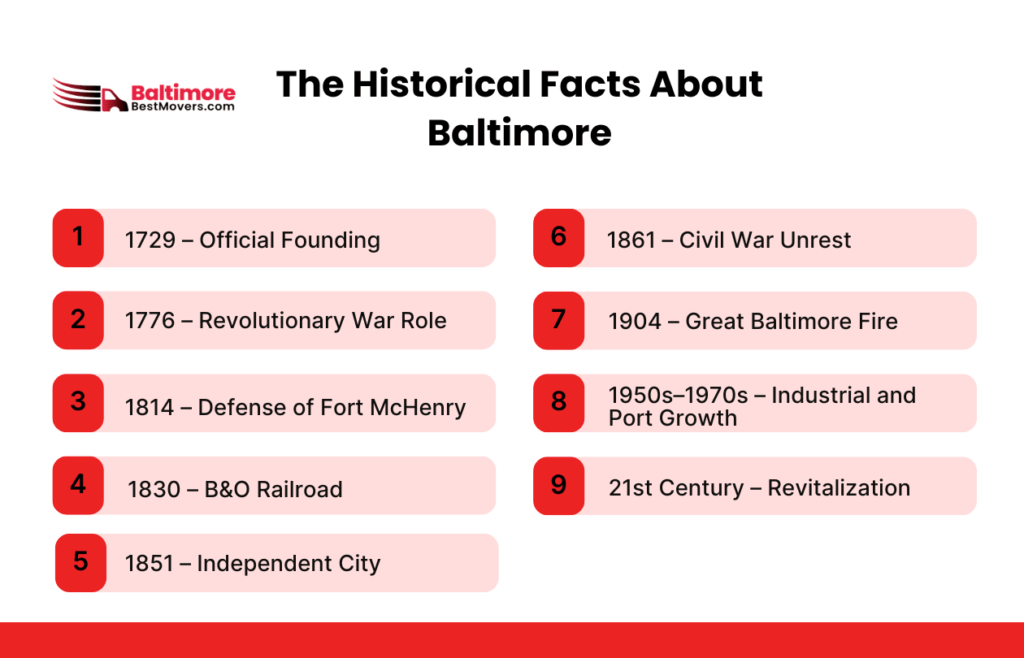
Baltimore has a rich and influential history that helped shape both Maryland and the United States. Below is a list of key historical milestones:
- 1729 – Official Founding: Baltimore was founded on July 30, 1729, and named after the Irish barony of Baltimore in County Longford.
- 1776 – Revolutionary War Role: During the American Revolution, Baltimore briefly served as the temporary capital of the United States when the Continental Congress met there.
- 1814 – Defense of Fort McHenry: The Battle of Baltimore inspired Francis Scott Key to write The Star-Spangled Banner, which later became the national anthem.
- 1830 – B&O Railroad: The Baltimore & Ohio Railroad began operations, becoming the first common carrier railroad in the United States.
- 1851 – Independent City: Baltimore became an independent city after the Maryland Constitution of 1851 separated it from Baltimore County.
- 1861 – Civil War Unrest: The Pratt Street Riot highlighted Baltimore’s divided loyalties at the start of the Civil War.
- 1904 – Great Baltimore Fire: A fire destroyed 70 blocks and 1,526 buildings in downtown, leading to systematic urban renewal.
- 1950s–1970s – Industrial and Port Growth: Baltimore became one of America’s busiest ports, with strong steel and shipping industries fueling economic expansion.
- 21st Century – Revitalization: Redevelopment of the Inner Harbor and the growth of Johns Hopkins University and Hospital shaped Baltimore’s modern identity.
What is the Cost of Living in Baltimore?
The average monthly cost of living in Baltimore is about $1,272.30 for a single person, excluding rent. This makes the city 29.9% less expensive than New York City when comparing living costs without rent. Housing adds to its affordability as Apartments.com reports that Baltimore’s housing costs are 13.8% lower than the national average. Some expenses are higher. Groceries cost 2.6% more, utilities are 12.7% higher, and transportation is 4.2% above the national average. Even with these increases, Baltimore remains one of the more practical and affordable options on the East Coast for students, families, and professionals.
What is the Tax Rate in Baltimore / Maryland?
The overall Baltimore City income tax rate is 3.2% in 2025. The city charges a real property tax rate of 2.248% and a personal property tax rate of 5.62%. Baltimore also applies a utility tax of 5.62% on services such as electricity and gas. At the state level, Maryland adds a 0.112% tax on real property, a 0.28% utility tax, and a 6% state sales tax on most goods and services. Together, these local and state taxes fund schools, public services, and infrastructure, making Baltimore one of the higher-taxed jurisdictions in Maryland.
What Is a Living Wage in Baltimore?
The living wage in Baltimore for a single adult with no children is $21.15 per hour, according to the MIT Living Wage Calculator. This is the estimated rate required to cover basic expenses such as housing, food, transportation, healthcare, and taxes without public assistance. For full-time work at 40 hours per week, this equals $3,384 per month or $40,608 annually.
For a household with two adults and two children, where both adults are employed, each must earn at least $27.17 per hour to support a basic standard of living. This amounts to about $4,347.2 per month per adult or $52,166.4 annually per adult.
By comparison, Maryland’s minimum wage in 2025 is $15 per hour, showing that many households would need dual incomes or higher wages to meet the city’s cost of living.
How Much Do Utilities Cost Per Month In Baltimore?
The average utility cost in Baltimore is about $380-$745 per month, including electricity, gas, water, sewer, internet, and phone. According to UHomes, utilities in Baltimore are around 10% pricier than the U.S. average.
Below is a breakdown of estimated monthly utility expenses:
| Utility | Cost Range |
| Electricity | $150–$275 per month |
| Gas | $50–$100 depending on season and usage |
| Water & Sewer | $30–$80 |
| Phone | $70–$140 |
| Internet | $80-150 |
| Total | $380-$745 |
These figures represent typical costs, but actual bills can vary with household size, property type, and seasonal energy demands. Residents in larger homes or during peak summer and winter months may see higher charges, while smaller apartments with moderate use may fall closer to the lower end of the range.
How Much Does a House Cost In Baltimore?
The median home price in Baltimore is approximately $244,000, according to Redfin. Realtor.com lists the median home listing price at $245,000, while the median sold home price is about $264,000.
Here is a breakdown of typical home prices in the city:
- Single-family homes: $336,500
- Townhouses: $220,000
- Condos/Co-ops: $175,000
For those looking to build a home, the average construction cost in Baltimore ranges from $155 to $260 per square foot, depending on design, materials, and location. For example, a 2,000-square-foot home could cost between $310,000 and $520,000 to build.
Is It Better To Rent Or Buy An Apartment In Baltimore?
Deciding whether to rent or buy in Baltimore depends on your finances, long-term goals, and how long you plan to stay in the city. With a median home price of about $244,000, Baltimore’s housing market is more affordable than in many major U.S. cities.
Using the 5% rule, you can estimate the monthly cost of homeownership. At $244,000, 5% equals $12,200 per year, or about $1,017 per month. This figure accounts for property taxes, maintenance, and the opportunity cost of capital but does not include mortgage payments.
Meanwhile, the average monthly rent for an apartment in Baltimore is $1,650. Based on this comparison, owning may be more cost-effective than renting if you plan to stay long-term. However, renting still provides flexibility and avoids upfront costs such as down payments and closing fees.
How Is The Current Job Market In Baltimore?
Baltimore’s workforce is active, with a labor force of 286,147, including 272,095 employed and 14,052 unemployed, resulting in an unemployment rate of 4.9%. The city’s labor force participation rate is 62.3%, showing steady engagement in the job market. Employment is supported by healthcare, education, logistics, and business services, with Johns Hopkins and the Port of Baltimore serving as major economic drivers.
Here are the top job categories in Baltimore by share of the workforce, as listed in the U.S. Bureau of Labor Statistics:
- Office and Administrative Support: 12.1%
- Management: 9%
- Transportation and Material Moving: 8.5%
- Business and Financial Operations: 8%
- Food Preparation and Serving Related: 7.6%
- Sales and Related: 7.6%
- Healthcare Practitioners and Technical: 6.8%
- Educational Instruction and Library: 6.4%
- Computer and Mathematical: 4.8%
- Construction and Extraction: 4.1%
Which Jobs Are In High Demand In Baltimore?
In Baltimore, jobs in healthcare, transportation, business/financial operations, and education are currently in high demand. These sectors are expanding due to the city’s large healthcare systems, the port and logistics infrastructure, and growing needs in schools and tech services. Some of the most sought-after positions in Baltimore, along with their typical annual salary ranges, include:
- Architect: $90,400 – $164,900
- Nurse Practitioner: $107,300 – $149,000
- Box Truck Owner Operator: $49,700 – $149,000
- Construction: $70,500 – $114,800
- Registered Nurse: $65,100 – $103,300
- Outpatient Clinic RN: $64,600 – $99,900
- Class A Truck Driver: $61,100 – $89,400
- Private Duty Home Care: $54,600 – $70,100
- Entomologist: $56,600 – $70,100
- Independent Courier: $37,300 – $62,600
Is Baltimore A Safe Place To Live?
Yes, Baltimore can be a safe place to live, particularly in neighborhoods with lower crime rates and strong community networks. Safety varies across the city, but recent progress shows encouraging trends.
According to the Baltimore Police Department (BPD), 2024 marked major improvements in public safety, with homicides decreasing by 23% (201 compared to 261 in 2023) and non-fatal shootings dropping by 34% (414 compared to 635 in 2023). These declines built on 2023’s historic record for the largest single-year reduction in homicides, reflecting the city’s commitment to reducing violence.
What Is the Crime Rate in Baltimore, Maryland?
The crime rate in Baltimore is about 59 crimes per 1,000 residents, which is higher than the U.S. average. According to recent statistics, the city recorded a total of 33,221 crimes annually, broken down into 8,935 violent crimes and 24,286 property crimes. This equals a violent crime rate of 15.81 per 1,000 residents and a property crime rate of 42.97 per 1,000 residents.
While these figures show that crime remains a challenge, Baltimore has also reported year-over-year declines in homicides and shootings, signaling progress in public safety efforts. For residents, crime rates vary greatly by neighborhood, with areas such as Federal Hill, Canton, and Roland Park ranking much safer than the citywide average.
How To Get Around Baltimore?
Getting around Baltimore is convenient thanks to the city’s mix of public transportation, walkable neighborhoods, and easy road access. The Maryland Transit Administration (MTA) operates buses, light rail, and the Metro SubwayLink, connecting key parts of the city to suburbs and regional hubs. For longer trips, Baltimore also has Amtrak service at Penn Station, making travel to Washington, D.C., Philadelphia, and New York straightforward.
Within the city, Baltimore is considered highly walkable in many neighborhoods, with grid-like streets and bike-friendly routes. Ridesharing services, scooters, and water taxis around the Inner Harbor add to mobility options. Driving is also common, supported by major highways like I-95 and I-83, which link Baltimore to other East Coast cities.
How To Use Public Transport In Baltimore?
Public transportation in Baltimore is managed by the Maryland Transit Administration (MTA), which operates buses, the Metro SubwayLink, and Light RailLink. Using these services is simple with the CharmPass app or the CharmCard, which allows you to pay fares electronically.
Here are the steps to use public transport in Baltimore:
- Plan Your Trip: Use the MTA website or CharmPass app to check routes and schedules.
- Choose Your Mode: Select between MTA buses, Metro SubwayLink, or Light RailLink depending on your destination.
- Buy Your Ticket: Purchase a single ride, a day pass, or a monthly pass through CharmPass or a ticket machine.
- Board and Validate: Scan your CharmPass QR code or tap your CharmCard when entering.
- Ride and Transfer: Transfers are available within the system, allowing easy connections between buses, metro, and light rail.
This system makes commuting affordable and straightforward, connecting Baltimore’s neighborhoods with nearby counties and regional hubs.
Are There Free Transit Options in Baltimore?
Yes, Baltimore provides free transit through the Charm City Circulator, a city-operated shuttle system designed to connect major neighborhoods and attractions. It is one of the most convenient ways to travel across downtown and nearby areas at no cost.
Operating Hours:
- Sunday: 9:00 AM – 8:00 PM
- Monday–Thursday: 7:00 AM – 8:00 PM
- Friday: 7:00 AM – Midnight
- Saturday: 9:00 AM – Midnight
Bus Frequency by Route:
- Purple Route: Every 13 minutes
- Orange Route: Every 10 minutes
- Cherry Route: Every 20 minutes
- Banner Route: Every 40 minutes
- Green Route: Every 20 minutes
Routes Covered:
- Green Route: City Hall → Fells Point → Johns Hopkins Hospital Campus
- Purple Route: 33rd Street → Federal Hill
- Orange Route: Hollins Market → Harbor East
- Banner Route: Inner Harbor → Fort McHenry
- Cherry Route: Inner Harbor → Cherry Hill
What Is The Weather Like in Baltimore Year Round?
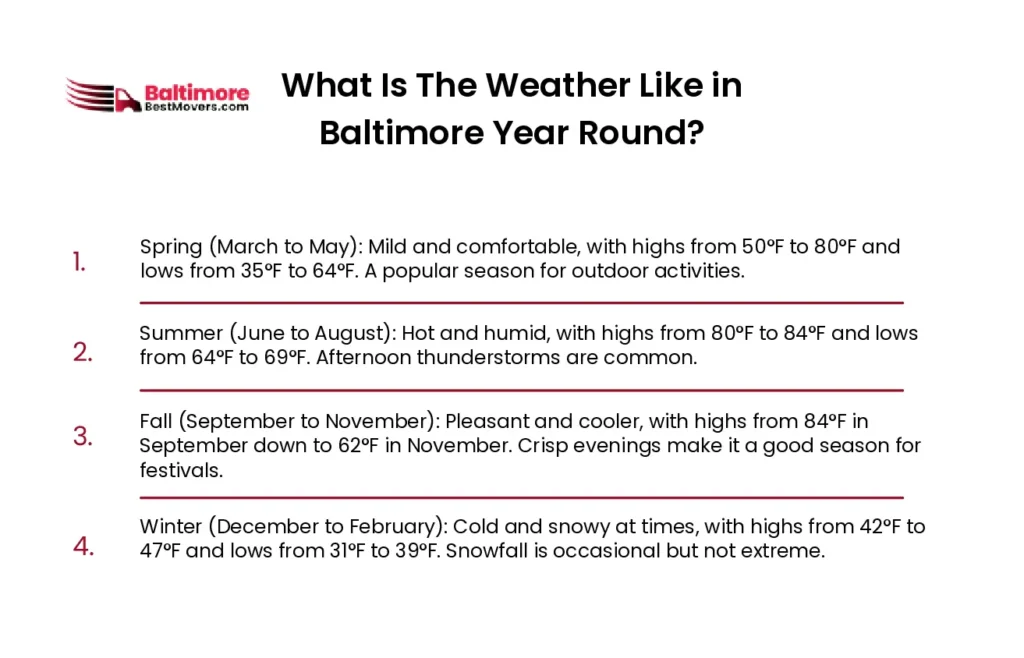
Baltimore experiences a humid subtropical climate, with hot and humid summers, cold winters, and mild, pleasant spring and fall seasons. The city’s location along the Chesapeake Bay influences its weather, creating a mix of maritime and inland conditions. Over the course of the year, temperatures typically range from 30°F to 89°F, rarely falling below 18°F or rising above 97°F.
Here is an overview of the seasonal weather in Baltimore:
- Spring (March to May): Mild and comfortable, with highs from 50°F to 80°F and lows from 35°F to 64°F. A popular season for outdoor activities.
- Summer (June to August): Hot and humid, with highs from 80°F to 84°F and lows from 64°F to 69°F. Afternoon thunderstorms are common.
- Fall (September to November): Pleasant and cooler, with highs from 84°F in September down to 62°F in November. Crisp evenings make it a good season for festivals.
- Winter (December to February): Cold and snowy at times, with highs from 42°F to 47°F and lows from 31°F to 39°F. Snowfall is occasional but not extreme.
The best time to visit or move to Baltimore is during spring (April–May) and fall (September–October), when temperatures are moderate, humidity is lower, and outdoor activities are at their best. These seasons also align with cultural events, baseball games at Camden Yards, and waterfront festivals, making the city especially vibrant. For new residents, moving during these periods can mean easier transitions compared to the extreme heat of summer or the chill of winter.
Does Baltimore have Good educational institutions?
Yes, Baltimore has a strong network of education institutions, from highly ranked universities to respected elementary and secondary schools. The city is known for its excellence in medicine, research, arts, and public education, making it a hub for students at all levels. Families moving to Baltimore can choose from both public and private schools, while higher education attracts students from across the nation and the world.
Elementary Schools:
- Roland Park Elementary/Middle
- Thomas Johnson Elementary/Middle
- Rodgers Forge Elementary School
- Hampstead Hill Academy
- Federal Hill Preparatory
Middle Schools:
- Roland Park Elementary/Middle
- Francis Scott Key Middle School
- Mount Royal Middle
- Medfield Heights Elementary School
- Turnbridge Public Charter School
High Schools:
- Baltimore Polytechnic Institute
- Baltimore City College
- Western School Of Technology & Env. Science
- Baltimore School For The Arts
- Western High School
Universities and Colleges:
- Johns Hopkins University
- University of Maryland, Baltimore
- Loyola University Maryland
- Morgan State University
- Maryland Institute College of Art (MICA)
What Are The Best Neighborhoods In Baltimore?
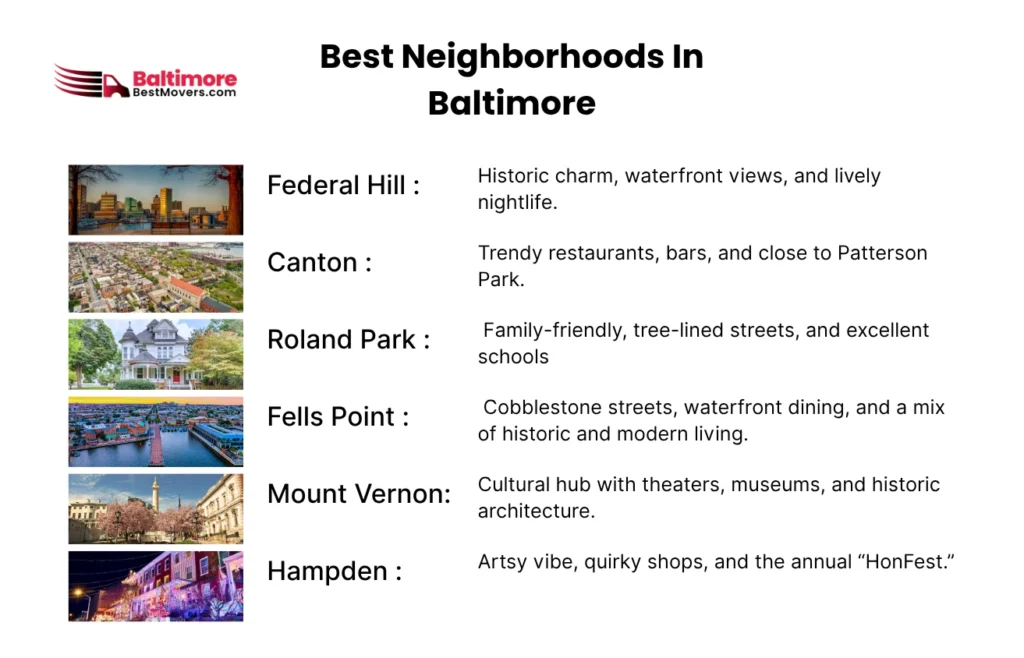
The best neighborhoods in Baltimore are Federal Hill, Canton, Roland Park, Fells Point, Mount Vernon, Hampden, and Locust Point. These areas are highly regarded for their safety, amenities, and quality of life, making them popular choices for families, professionals, and students.
Top neighborhoods in Baltimore:
- Federal Hill: Historic charm, waterfront views, and lively nightlife.
- Canton: Trendy restaurants, bars, and close to Patterson Park.
- Roland Park: Family-friendly, tree-lined streets, and excellent schools.
- Fells Point: Cobblestone streets, waterfront dining, and a mix of historic and modern living.
- Mount Vernon: Cultural hub with theaters, museums, and historic architecture.
- Hampden: Artsy vibe, quirky shops, and the annual “HonFest.”
Which are the Safest Neighborhoods of Baltimore?
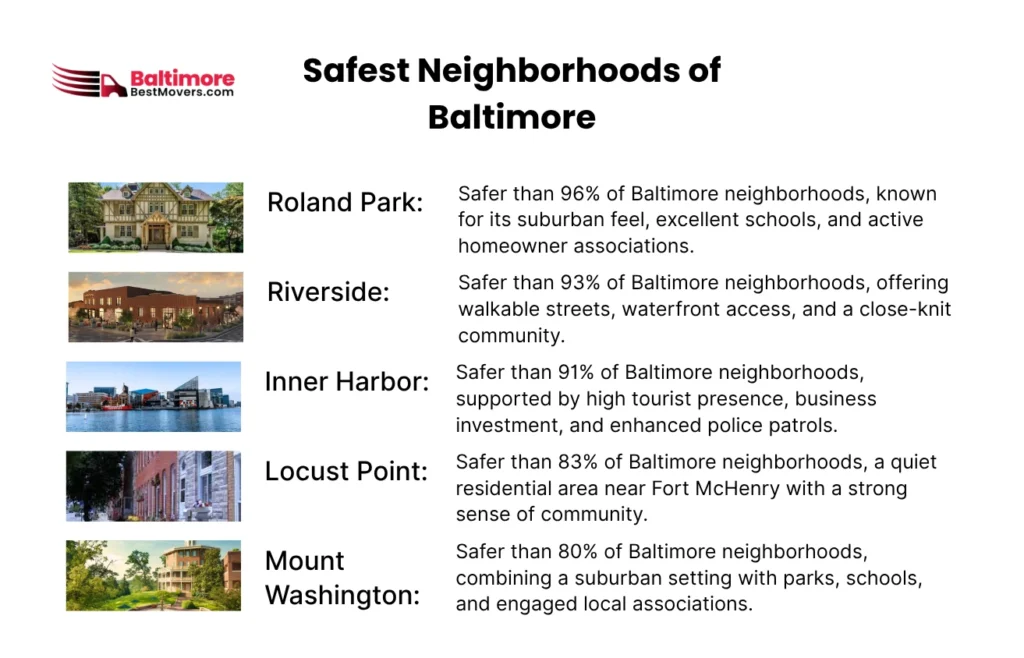
The safest neighborhoods in Baltimore are Roland Park, Riverside, Inner Harbor, Locust Point, and Mount Washington. These areas consistently rank among the most secure in the city, with low crime rates, strong community ties, and easy access to amenities. They are popular with families, professionals, and students seeking both safety and convenience.
Safest Neighborhoods in Baltimore:
- Roland Park: Safer than 96% of Baltimore neighborhoods, known for its suburban feel, excellent schools, and active homeowner associations.
- Riverside: Safer than 93% of Baltimore neighborhoods, offering walkable streets, waterfront access, and a close-knit community.
- Inner Harbor: Safer than 91% of Baltimore neighborhoods, supported by high tourist presence, business investment, and enhanced police patrols.
- Locust Point: Safer than 83% of Baltimore neighborhoods, a quiet residential area near Fort McHenry with a strong sense of community.
- Mount Washington: Safer than 80% of Baltimore neighborhoods, combining a suburban setting with parks, schools, and engaged local associations.
Which are the Less Safe / Dangerous Neighborhoods of Baltimore?
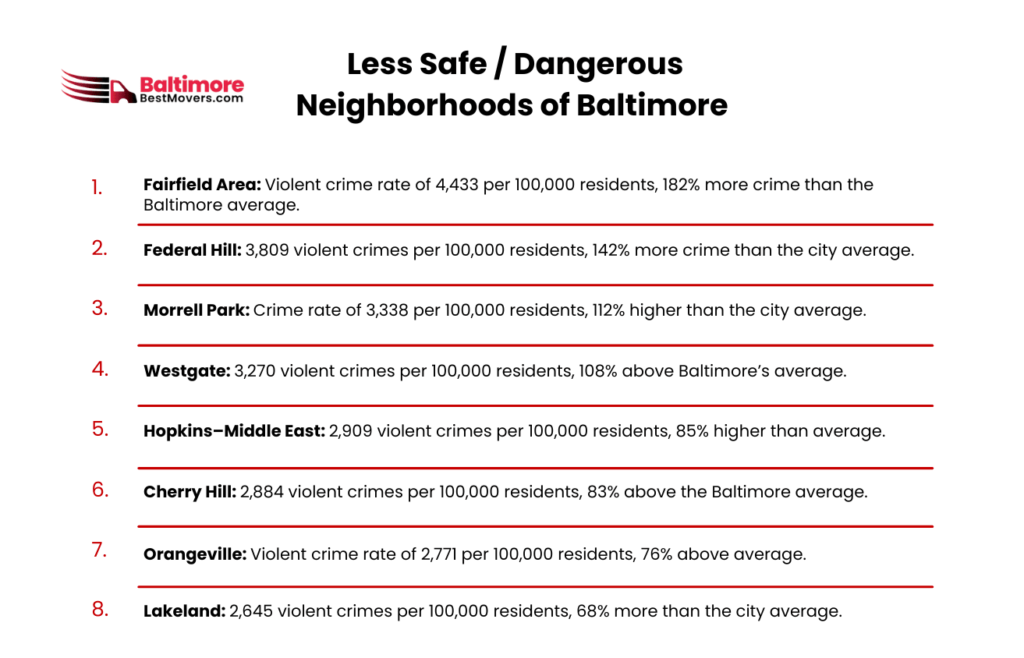
The less safe neighborhoods in Baltimore include Fairfield Area, Federal Hill, Morrell Park, Westgate, Hopkins–Middle East, Cherry Hill, Orangeville, and Lakeland. These areas report violent crime rates significantly higher than the citywide average, making them some of the most dangerous in Baltimore.
Less Safe Neighborhoods in Baltimore:
- Fairfield Area: Violent crime rate of 4,433 per 100,000 residents, 182% more crime than the Baltimore average.
- Federal Hill: 3,809 violent crimes per 100,000 residents, 142% more crime than the city average.
- Morrell Park: Crime rate of 3,338 per 100,000 residents, 112% higher than the city average.
- Westgate: 3,270 violent crimes per 100,000 residents, 108% above Baltimore’s average.
- Hopkins–Middle East: 2,909 violent crimes per 100,000 residents, 85% higher than average.
- Cherry Hill: 2,884 violent crimes per 100,000 residents, 83% above the Baltimore average.
- Orangeville: Violent crime rate of 2,771 per 100,000 residents, 76% above average.
- Lakeland: 2,645 violent crimes per 100,000 residents, 68% more than the city average.
Which are the Richest Neighborhoods of Baltimore?
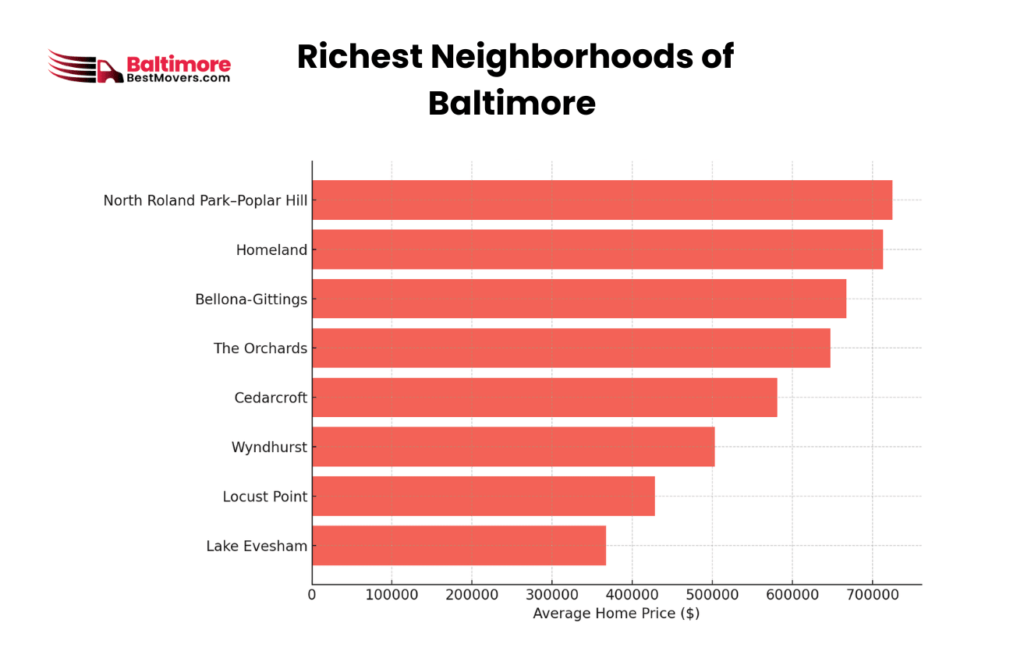
The richest neighborhoods in Baltimore include North Roland Park–Poplar Hill, Homeland, Bellona-Gittings, The Orchards, Cedarcroft, Wyndhurst, Locust Point, and Lake Evesham. These areas are known for their higher home values, well-maintained properties, and strong community appeal, making them some of the most desirable places to live in the city.
Richest Neighborhoods in Baltimore by Average Home Value:
- North Roland Park–Poplar Hill ($724,917): A prestigious area with large historic homes, top-ranked schools, and a quiet, suburban atmosphere.
- Homeland ($713,109): Known for tree-lined streets, lakes, and preserved architecture that attract long-term residents.
- Bellona-Gittings ($667,596): Offers spacious homes, exclusivity, and a reputation for safety, making it ideal for established families.
- The Orchards ($647,592): A sought-after residential district with elegant homes and proximity to top private schools.
- Cedarcroft ($580,973): Features Tudor-style houses, a strong community association, and convenient access to amenities.
- Wyndhurst ($503,280): Popular with families due to nearby schools and a mix of historic and modern residences.
- Locust Point ($428,474): Combines waterfront living, modern townhomes, and access to Fort McHenry, appealing to professionals.
- Lake Evesham ($367,273): A smaller but respected neighborhood with single-family homes and a strong community atmosphere.
Which are the More Affordable / Worst (in terms of amenities) Neighborhoods of Baltimore?
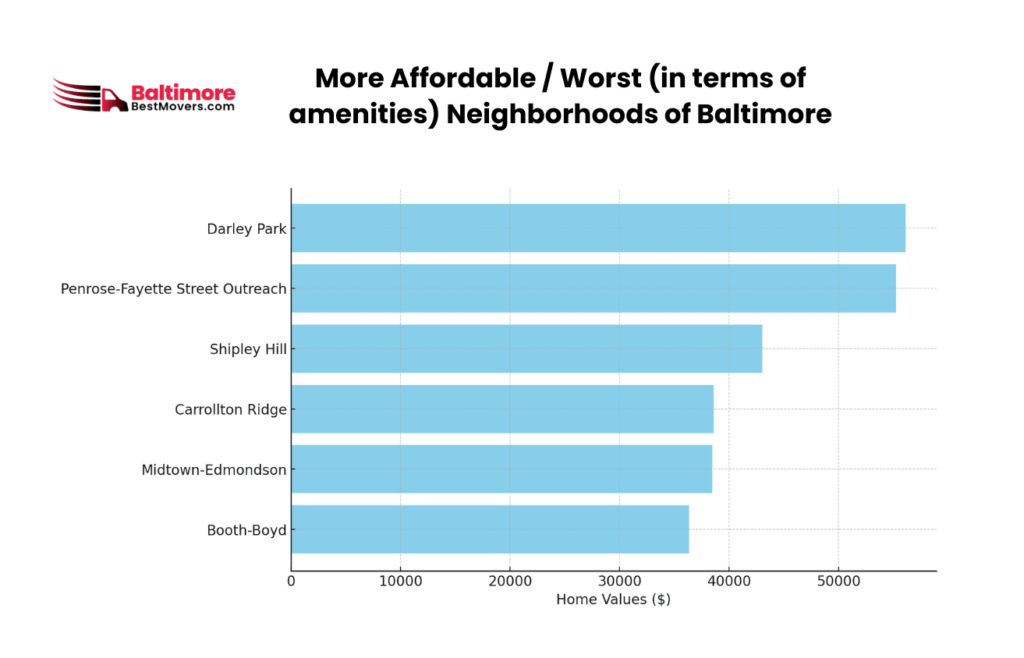
The most affordable but less desirable neighborhoods in Baltimore include Booth-Boyd, Midtown-Edmondson, Carrollton Ridge, Shipley Hill, Penrose-Fayette Street Outreach, Darley Park, Sandtown-Winchester, and Harlem Park. These areas have the lowest home values in the city, but they also face challenges such as higher crime rates, vacant housing, and fewer amenities.
Most Affordable / Worst Neighborhoods in Baltimore by Home Value:
- Booth-Boyd ($36,352): Lowest home values in Baltimore, with persistent poverty and limited opportunities.
- Midtown-Edmondson ($38,458): Affordable rowhomes, but high vacancy rates and crime affect livability.
- Carrollton Ridge ($38,570): Very low home prices, though safety and infrastructure remain concerns.
- Shipley Hill ($43,025): Among the lowest values in the city, with higher crime and fewer amenities.
- Penrose-Fayette Street Outreach ($55,211): Affordable rowhouses but limited services and safety concerns.
- Darley Park ($56,114): Houses are inexpensive, though the area faces redevelopment challenges.
What Industry Is Baltimore Known For?
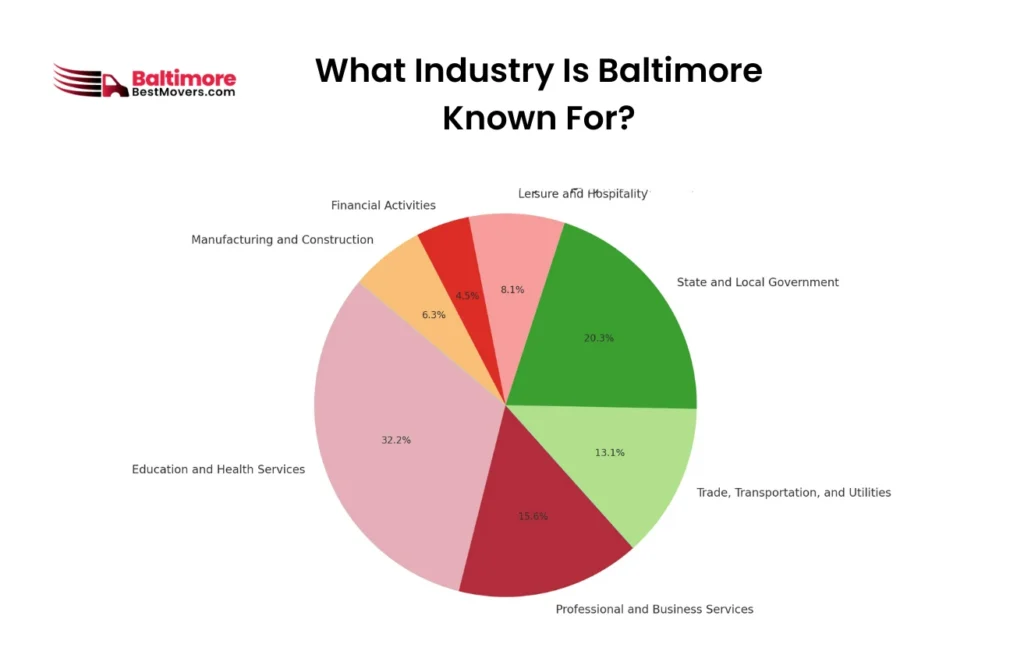
Baltimore’s economy is broad and resilient, driven by healthcare, education, professional services, government, and trade. With nearly 348,000 jobs across public and private sectors in 2024, the city’s industries provide both stability and growth opportunities.
Key Industries in Baltimore by Employment (2024):
- Education and Health Services (29.8%): The city’s largest sector with 103,614 employees. Anchored by Johns Hopkins University and Hospital and the University of Maryland Medical Center, this sector supports research, medical innovation, and higher education.
- Professional and Business Services (14.4%): Employs 50,209 across consulting, technology, and legal services. Baltimore’s growing cybersecurity and biotech startups add to this sector’s strength.
- Trade, Transportation, and Utilities (12.1%): With 42,195 workers, this sector benefits from the Port of Baltimore, one of the busiest U.S. ports for automobiles and shipping, supporting logistics and warehousing.
- State and Local Government (18.8% combined): Employs 65,567 across public administration, education, and safety services. These jobs provide stability and strong union support.
- Leisure and Hospitality (7.5%): 26,200 employees work in Baltimore’s restaurants, hotels, and cultural venues. Tourism hubs like the Inner Harbor and Camden Yards drive demand.
- Financial Activities (4.2%): With 14,635 employees, Baltimore’s finance sector is strong in banking, insurance, and investment firms. Average weekly wages of $3,328 highlight its high-paying roles.
- Manufacturing and Construction (5.8% combined): More than 20,000 workers produce pharmaceuticals, defense goods, and construction projects that shape the city’s infrastructure.
What Sports Are Popular In Baltimore?
Sports are a central part of life in Baltimore, with baseball and football leading the way. The city is home to the Baltimore Orioles (MLB) at Camden Yards and the Baltimore Ravens (NFL) at M&T Bank Stadium, both drawing passionate fan bases. Lacrosse also has deep roots, with Baltimore often called the “lacrosse capital” of the U.S., supported by strong college programs like Johns Hopkins University. In addition, basketball, soccer, and running events remain popular among residents, making sports culture an important part of Baltimore’s identity.
What Is The Culture Like In Baltimore?
Baltimore’s culture is a unique mix of history, creativity, and community spirit, earning it the nickname “Charm City.” The city has a long tradition of arts and music, with institutions like the Baltimore Symphony Orchestra, Hippodrome Theatre, and Baltimore Museum of Art highlighting its cultural depth. Music is especially strong, from jazz and hip-hop to classical and indie rock.
Local pride shines through community festivals such as Artscape, the nation’s largest free arts festival, and neighborhood block parties that reflect the city’s diverse character. Baltimore’s culture is also defined by its culinary scene, with steamed blue crabs and Old Bay seasoning serving as city icons. Together, these traditions give Baltimore a rich and welcoming cultural identity.
What Are The Best Things To Do In Baltimore?
The best things to do in Baltimore include exploring the Inner Harbor, visiting the National Aquarium, and catching a baseball game at Oriole Park at Camden Yards. Top attractions also include Fort McHenry National Monument and Historic Shrine, the birthplace of the national anthem, and cultural gems like the Baltimore Museum of Art, B&O Railroad Museum, and the Walters Art Museum. Visitors can enjoy shopping and dining at Fells Point, walking through the historic streets of Federal Hill, or relaxing at Patterson Park. For sports fans, cheering for the Baltimore Ravens at M&T Bank Stadium is a must.
What Are The Top Attractions to See In Baltimore?
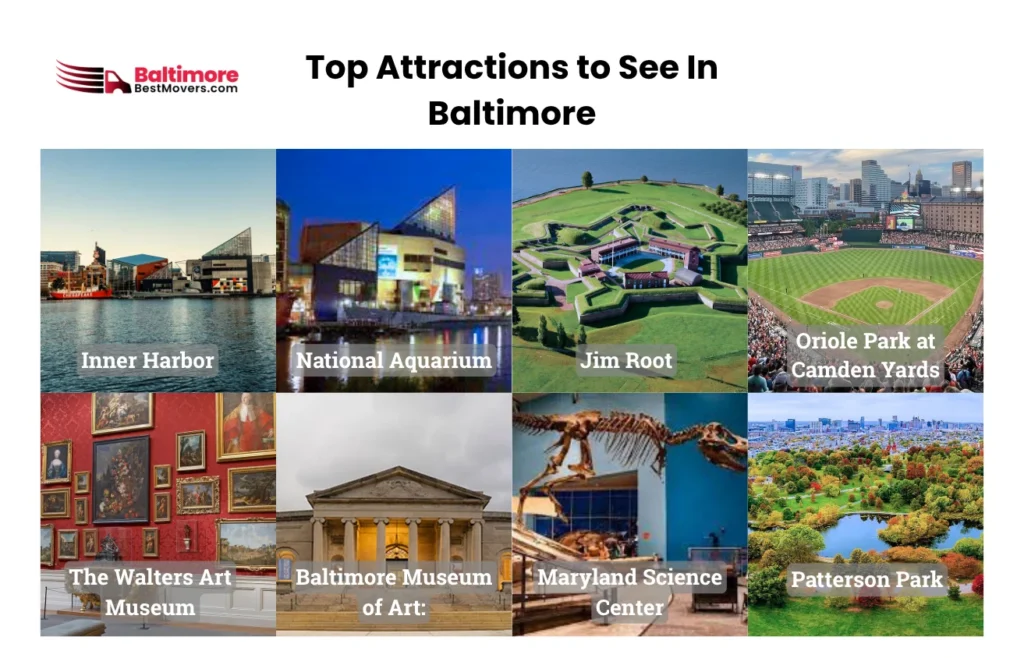
The top attractions to see in Baltimore highlight the city’s history, culture, and waterfront beauty. From iconic landmarks to museums, these sites draw both residents and visitors year-round.
Top Attractions in Baltimore are:
- Inner Harbor: A central hub with shops, dining, and water taxis.
- National Aquarium: World-class aquarium with over 20,000 animals.
- Fort McHenry National Monument: Historic site where the Star-Spangled Banner was written.
- Oriole Park at Camden Yards: A celebrated ballpark and home of the Baltimore Orioles.
- The Walters Art Museum: Free-admission museum with global art collections.
- Baltimore Museum of Art: Famous for its extensive Matisse collection.
- Maryland Science Center: Interactive exhibits and a planetarium, perfect for families.
- Patterson Park: A large urban park offering trails, sports, and community events.
What Are The Top Museums You Can Visit In Baltimore?
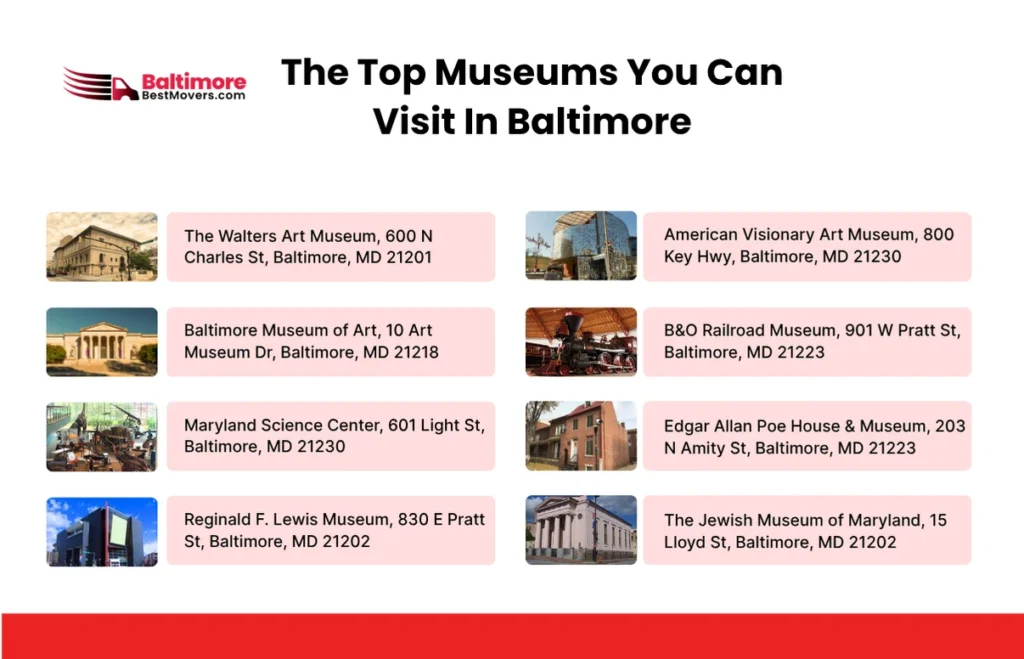
Baltimore is home to an impressive collection of museums that showcase its history, culture, and art. From world-renowned art collections to interactive science exhibits, the city’s museums offer something for everyone.
Here are some of the top museums to explore in Baltimore:
- The Walters Art Museum, 600 N Charles St, Baltimore, MD 21201: A free museum featuring global art collections spanning from ancient Egypt to 20th-century Europe.
- Baltimore Museum of Art, 10 Art Museum Dr, Baltimore, MD 21218: Famous for the world’s largest collection of Matisse works, along with contemporary exhibits.
- Maryland Science Center, 601 Light St, Baltimore, MD 21230: Offers hands-on exhibits, a planetarium, and an observatory, ideal for families.
- Reginald F. Lewis Museum, 830 E Pratt St, Baltimore, MD 21202: Focused on African American history and culture in Maryland and beyond.
- American Visionary Art Museum, 800 Key Hwy, Baltimore, MD 21230: Celebrates creativity and self-taught artists with unique exhibitions.
- B&O Railroad Museum, 901 W Pratt St, Baltimore, MD 21223: Showcases the birthplace of American railroading with historic locomotives and cars.
- Edgar Allan Poe House & Museum, 203 N Amity St, Baltimore, MD 21223: Preserves the home of the famous author and poet, offering insight into his life.
- The Jewish Museum of Maryland, 15 Lloyd St, Baltimore, MD 21202: Explores Jewish heritage, immigration, and community history in Baltimore.
What Are the Famous Parks In Baltimore?
Baltimore has several well-known parks that provide outdoor recreation, historic landmarks, and scenic views. These green spaces are central to community life and are popular for both locals and visitors.
Here are some of the most famous parks in the city:
- Patterson Park, 2601 E Baltimore St, Baltimore, MD 21224: One of Baltimore’s oldest parks, featuring sports fields, playgrounds, trails, and the iconic Pagoda.
- Druid Hill Park, 900 Druid Park Lake Dr, Baltimore, MD 21217: A large urban park that houses the Maryland Zoo, lakes, and extensive walking paths.
- Federal Hill Park, 300 Warren Ave, Baltimore, MD 21230: Offers panoramic views of the Inner Harbor and is steeped in Revolutionary War history.
- Canton Waterfront Park, 3001 Boston St, Baltimore, MD 21224: A waterfront park known for festivals, fishing, and open-air recreation.
- Gwynns Falls/Leakin Park, 4921 Windsor Mill Rd, Baltimore, MD 21207: The city’s largest park, with wooded trails, nature programs, and historic landmarks.
- Carroll Park, 1500 Washington Blvd, Baltimore, MD 21230: Features athletic fields, a golf course, and the historic Mount Clare Mansion.
- Latrobe Park, 1627 E Fort Ave, Baltimore, MD 21230: A family-friendly space with sports fields, playgrounds, and dog areas in Locust Point.
- Middle Branch Park, 3301 Waterview Ave, Baltimore, MD 21230: A waterfront park that connects to Baltimore’s greenway system, ideal for kayaking and nature walks.
Does Baltimore Have Beaches or Waterfronts?
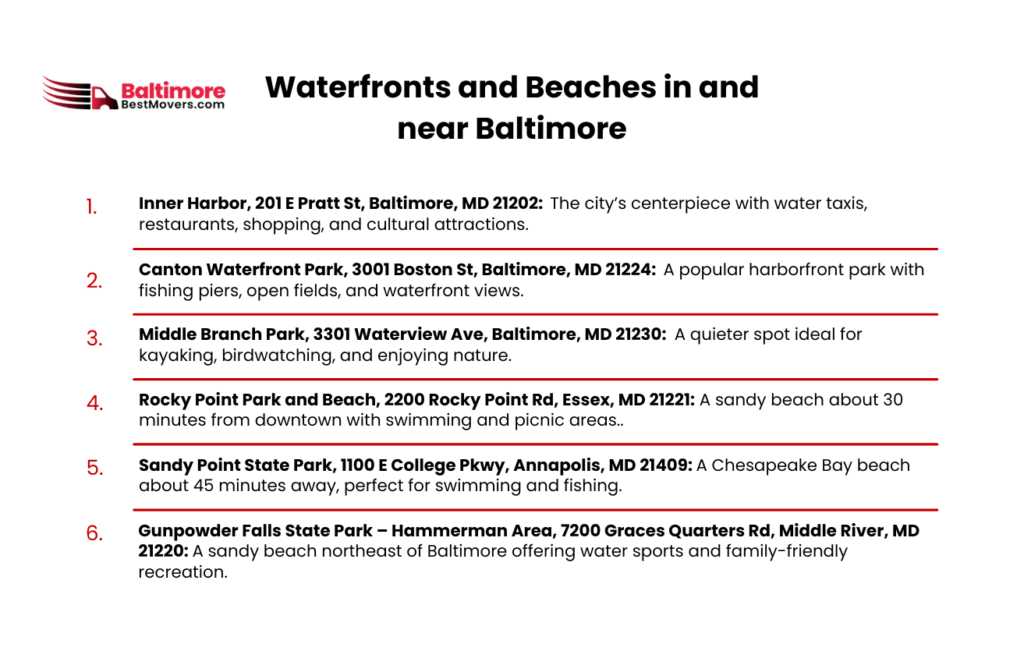
Yes, Baltimore has a scenic waterfront, but no traditional ocean beaches within the city limits. Instead, residents enjoy the Inner Harbor and waterfront parks for recreation, while sandy beaches are located just outside the city along the Chesapeake Bay.
Waterfronts and Beaches in and near Baltimore are:
- Inner Harbor, 201 E Pratt St, Baltimore, MD 21202: The city’s centerpiece with water taxis, restaurants, shopping, and cultural attractions.
- Canton Waterfront Park, 3001 Boston St, Baltimore, MD 21224: A popular harborfront park with fishing piers, open fields, and waterfront views.
- Middle Branch Park, 3301 Waterview Ave, Baltimore, MD 21230: A quieter spot ideal for kayaking, birdwatching, and enjoying nature.
- Rocky Point Park and Beach, 2200 Rocky Point Rd, Essex, MD 21221: A sandy beach about 30 minutes from downtown with swimming and picnic areas.
- Sandy Point State Park, 1100 E College Pkwy, Annapolis, MD 21409: A Chesapeake Bay beach about 45 minutes away, perfect for swimming and fishing.
- Gunpowder Falls State Park – Hammerman Area, 7200 Graces Quarters Rd, Middle River, MD 21220: A sandy beach northeast of Baltimore offering water sports and family-friendly recreation.
What Are The Best Restaurants In Baltimore?
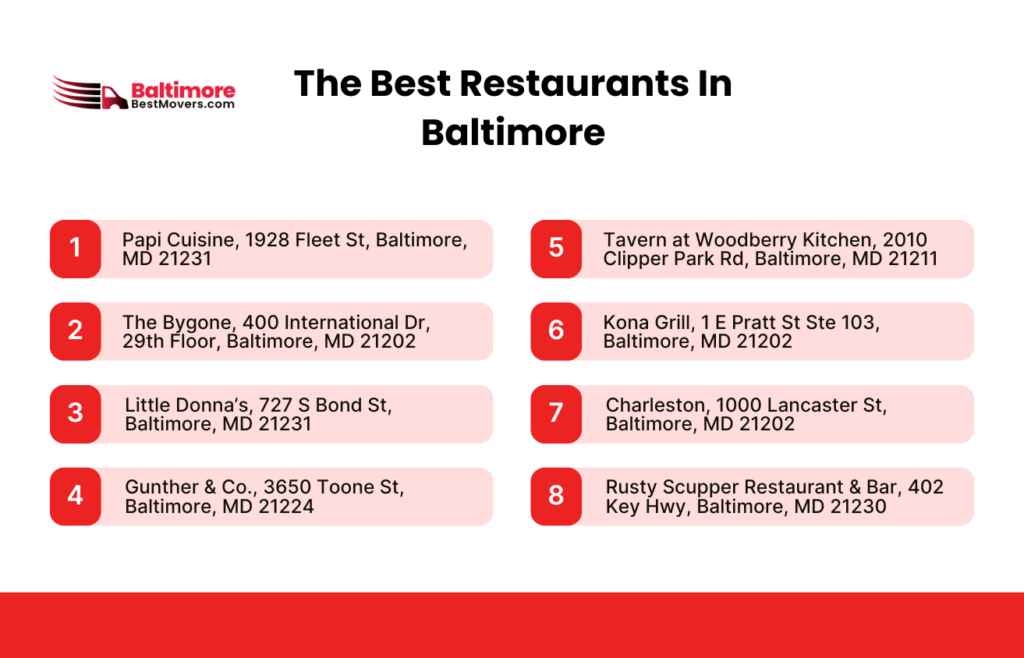
Baltimore’s dining scene blends upscale restaurants, creative fusion spots, and classic seafood houses. From rooftop views to harborfront dining, the city offers something for every taste. Here are some of the best restaurants to check out in Baltimore:
- Papi Cuisine, 1928 Fleet St, Baltimore, MD 21231: A trendy Black-owned restaurant in Fells Point, known for bold Afro-Caribbean fusion dishes like crab cake egg rolls.
- The Bygone, 400 International Dr, 29th Floor, Baltimore, MD 21202: An upscale rooftop restaurant offering modern American cuisine with sweeping views of the Inner Harbor.
- Little Donna’s, 727 S Bond St, Baltimore, MD 21231: A cozy neighborhood spot known for seasonal small plates and a creative rotating menu.
- Gunther & Co., 3650 Toone St, Baltimore, MD 21224: A stylish eatery in a historic brewery, serving wood-fired dishes and global-inspired cuisine.
- Tavern at Woodberry Kitchen, 2010 Clipper Park Rd, Baltimore, MD 21211: A spinoff of the acclaimed Woodberry Kitchen, featuring locally sourced dishes in a casual tavern setting.
- Kona Grill, 1 E Pratt St Ste 103, Baltimore, MD 21202: A sleek restaurant offering sushi, American classics, and happy hour specials near the Inner Harbor.
- Charleston, 1000 Lancaster St, Baltimore, MD 21202: A fine dining landmark led by Chef Cindy Wolf, specializing in Southern-inspired cuisine with French flair.
- Rusty Scupper Restaurant & Bar, 402 Key Hwy, Baltimore, MD 21230: A waterfront seafood staple with panoramic harbor views, known for Maryland crab cakes.
What Food Is Baltimore Known For?
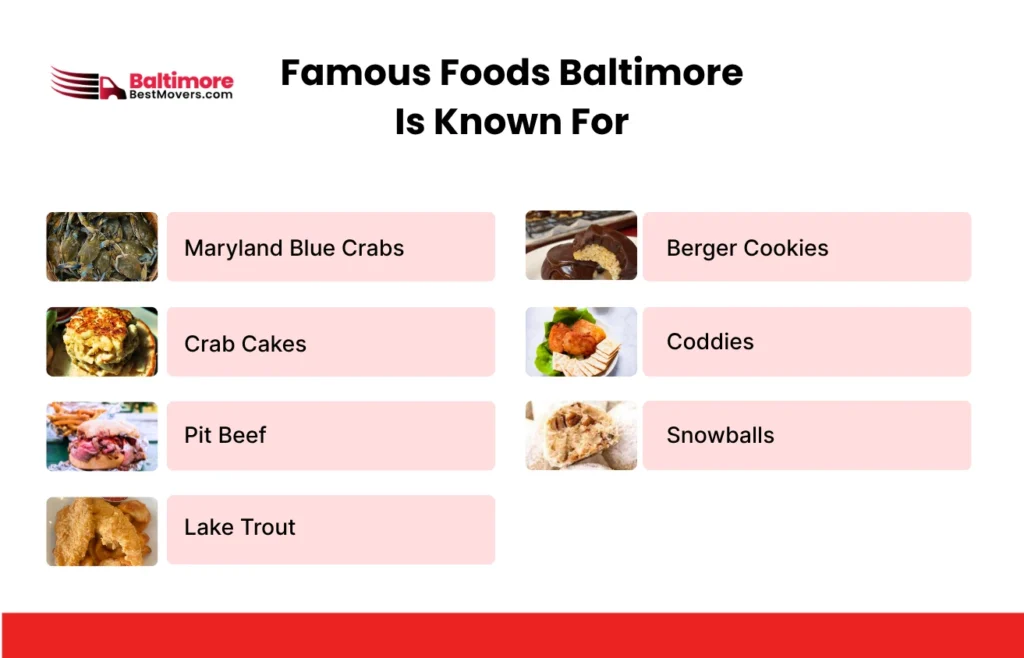
Baltimore is famous for its seafood, comfort foods, and dishes seasoned with the city’s signature Old Bay flavor. From Maryland blue crabs to hearty local specialties, food is a central part of Baltimore’s culture and identity. Here are some of the most iconic foods the city is known for:
- Maryland Blue Crabs: Steamed crabs coated in Old Bay seasoning, a local tradition often enjoyed at crab feasts.
- Crab Cakes: Jumbo lump crab meat formed into patties, lightly seasoned, and either broiled or fried.
- Pit Beef: Baltimore’s version of barbecue, featuring thinly sliced beef served on a kaiser roll with horseradish.
- Lake Trout: A deep-fried whitefish sandwich that’s a popular street and takeout food.
- Berger Cookies: A dense shortbread-style cookie topped with thick chocolate fudge icing, a beloved local dessert.
- Coddies: A snack made of mashed potatoes and salted cod, typically served on crackers with mustard.
- Snowballs: Shaved ice topped with flavored syrups and often finished with marshmallow cream, a summer favorite.
What Are The Best Places to Shop in Baltimore?
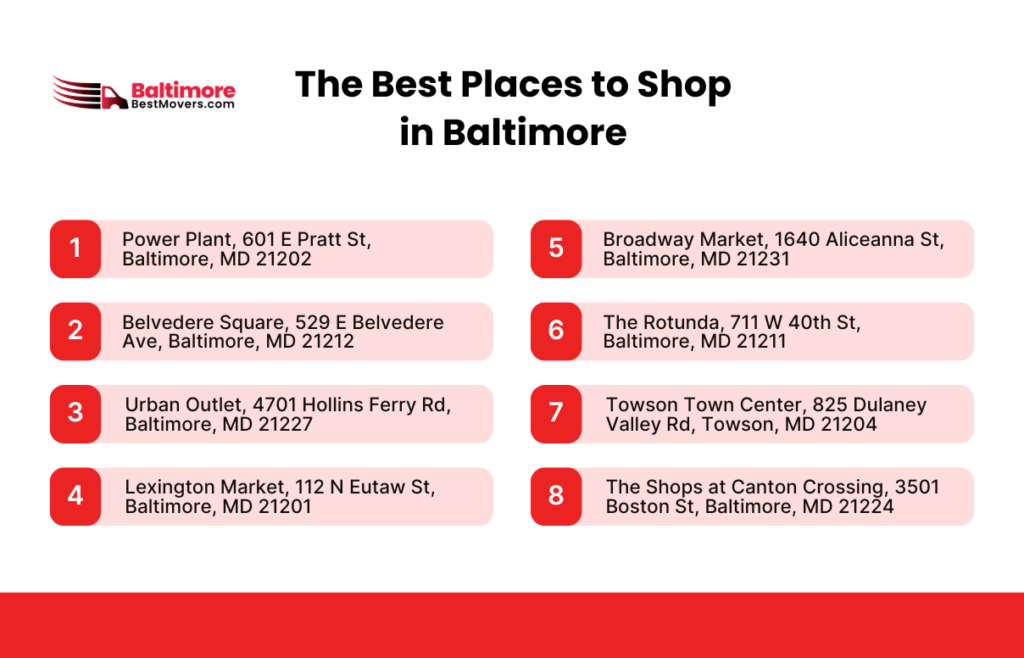
Baltimore has a diverse shopping scene that blends historic markets, modern malls, and boutique destinations. Whether you are searching for fresh local foods, national retailers, or unique specialty shops, the city offers options for every taste and budget.
Some of the best places to shop in Baltimore are listed below:
- Power Plant, 601 E Pratt St, Baltimore, MD 21202: A lively shopping and entertainment complex near the Inner Harbor with retail stores, dining, and nightlife.
- Belvedere Square, 529 E Belvedere Ave, Baltimore, MD 21212: A local favorite featuring specialty shops, artisan food vendors, and seasonal events.
- Urban Outlet, 4701 Hollins Ferry Rd, Baltimore, MD 21227: Known for discounted fashion, shoes, and home goods, making it popular with bargain shoppers.
- Lexington Market, 112 N Eutaw St, Baltimore, MD 21201: One of the oldest public markets in the U.S., offering fresh seafood, baked goods, and Baltimore’s famous crab cakes.
- Broadway Market, 1640 Aliceanna St, Baltimore, MD 21231: A historic Fells Point market with local eateries, produce, and artisanal goods.
- The Rotunda, 711 W 40th St, Baltimore, MD 21211: A mixed-use retail center with boutique shops, restaurants, and entertainment venues.
- Towson Town Center, 825 Dulaney Valley Rd, Towson, MD 21204: A premier suburban mall just outside Baltimore with luxury brands, department stores, and dining.
- The Shops at Canton Crossing, 3501 Boston St, Baltimore, MD 21224: A modern shopping complex featuring popular national retailers, casual dining, and convenience stores.
Who Are the Utility Providers in Baltimore?
Baltimore’s main utility providers include Baltimore Gas and Electric (BGE) for electricity and natural gas, and the Baltimore City Department of Public Works (DPW) for water, sewer, trash, and recycling services. Internet and cable are offered by major providers such as Xfinity, Verizon Fios, and T-Mobile Home Internet, while phone service is widely available through Verizon, AT&T, and T-Mobile. Together, these providers ensure reliable access to essential utilities for residents across the city.
How To Change Address on a License in Maryland?
If you move to or within Maryland, you must update your driver’s license address within 30 days. Here is how to do it through the Maryland Vehicle Administration (MVA):
- Visit the Maryland MVA website at mva.maryland.gov and go to the Change Address section.
- Provide your login details or create a new account by clicking Sign Up.
- Provide your driver’s license number, date of birth, and the last four digits of your Social Security number.
- For in-person updates, bring proof of your new address, such as a utility bill, bank statement, or lease agreement.
- If updated online, your new license will be mailed to your new address.
What are the Pros and Cons of Moving to Baltimore?
Moving to Baltimore comes with several advantages, including a relatively affordable cost of living, especially compared to nearby cities like Washington, D.C., and Philadelphia. Housing prices are lower than the national average, and the city offers strong employment opportunities in healthcare, education, shipping, and technology. Baltimore is also home to prestigious universities such as Johns Hopkins and the University of Maryland, alongside a vibrant cultural scene with museums, music, and professional sports teams. Families and young professionals alike find neighborhoods such as Federal Hill, Canton, and Roland Park appealing for safety, amenities, and community spirit.
On the other hand, Baltimore faces challenges that may affect new residents. The city has higher-than-average crime rates, particularly in certain neighborhoods, which makes choosing the right area important. Taxes, including property and local income taxes, are also higher than in many other U.S. cities. While public transportation is available, many residents find a car more convenient for daily commuting. Despite these challenges, many people view Baltimore as a rewarding place to live due to its combination of affordability, cultural richness, and proximity to major East Coast hubs.
Is Moving to Baltimore Worth It For You? Get a Free Moving Quote / Estimate?
Moving to Baltimore can be a rewarding choice if you are seeking a balance of affordability, opportunity, and culture. With lower housing costs than many nearby East Coast cities, strong job sectors in healthcare and education, and vibrant neighborhoods filled with history and charm, Baltimore offers something for families, students, and professionals alike. Its cultural mix, from world-class museums to legendary crab feasts, creates a lifestyle that feels both rich and welcoming.If you are ready to make the move, hiring a professional moving company can make the transition simple and stress-free. By getting a free moving quote, you can plan costs, compare options, and ensure your relocation is handled smoothly, allowing you to settle into “Charm City” with confidence.


